


Research & Publications
Research
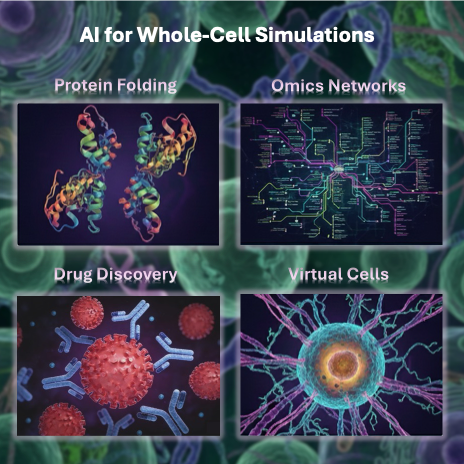
1. AI for Whole-Cell Simulations:
AI-driven whole-cell simulations represent a paradigm shift in biological discovery, unlocking unprecedented power to model cellular complexity at molecular resolution. By integrating machine learning with biophysical principles, AI transcends traditional computational limits—predicting protein folding in milliseconds instead of months, simulating metabolic networks in dynamic microenvironments, and forecasting emergent cellular behaviors impossible to capture experimentally. This synergy enables virtual experiments on rare cell types, disease states, or drug interactions at minimal cost. AI for whole cells will revolutionize our capacity to decode life’s machinery—making the invisible visible, the untestable testable, and transforming biology from observation to prediction.
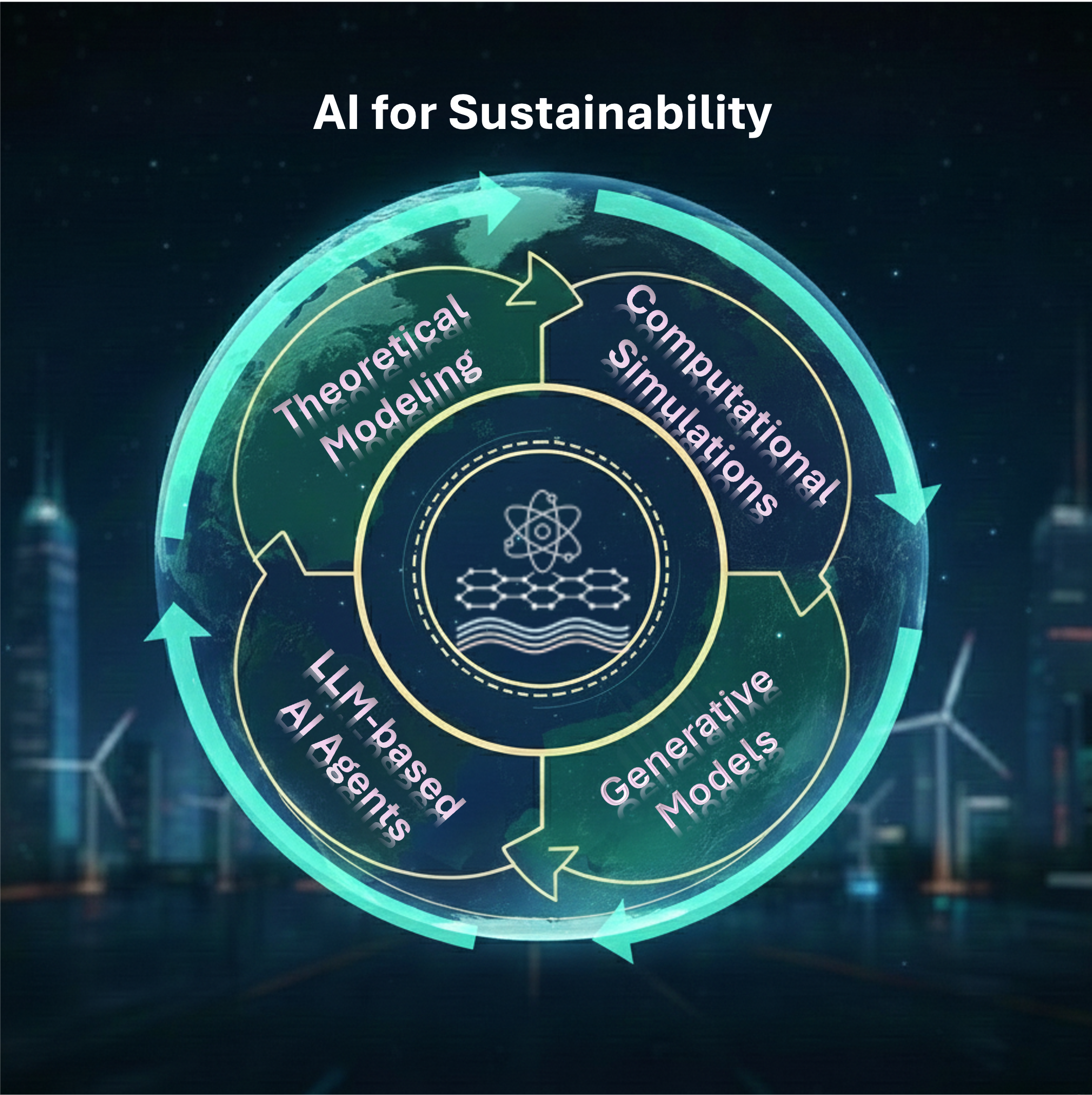
2. AI for Sustainability:
AI-driven sustainability provides a unique chance to incorporate the power of fundamental laws in physics, chemistry, and earth sciences into deep learning architectures. By integrating theoretical modeling, computational simulations, generative models, and AI agents, our mission is to bridge the gap between isolated applications and the complex, equilibrium, non-equilibrium, and multiscale dynamics of physical, chemical, and climate systems, from modeling mass transport in aqueous solutions and at solid-state interfaces to understanding the carbon cycle and the dynamics of climate change. This fusion allows us to construct "Digital Twins" of physical and environmental processes that respect scientific constraints while enabling the predictive design and optimization of sustainable systems and solutions, which finally leads to a green chemistry and carbon-neutral future.
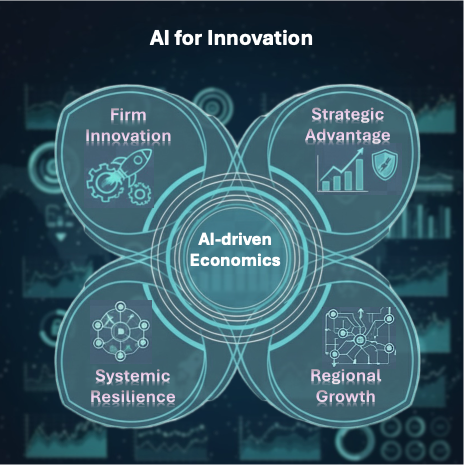
3. AI for Innovation, Firm Competitiveness and Regional Growth:
AI-driven economics research is catalyzing a revolution in innovation, firm competitiveness, and regional growth, turning data into strategic advantage and systemic resilience. By integrating machine learning with economic theory, AI transcends traditional constraints—optimizing operations in real-time, forecasting market shifts with unprecedented granularity, and uncovering hidden opportunities through predictive innovation ecosystems. This integration enables businesses to accelerate innovation, adapt swiftly to market fluctuations, and secure a competitive advantage in turbulent landscapes. At the regional scale, AI maps talent-capital-technology clusters, simulates policy impacts (e.g., tax incentives, infrastructure investments, trade war shocks), and tracks economic spillovers to foster inclusive startup cultures and attract high-impact investments. By transforming economic complexity into actionable strategy, AI shifts firms from reactive adaptation to proactive disruption and empowers regions to ignite sustainable, broad-based prosperity—turning unpredictability into opportunity. AI becomes a springboard for inclusive economic dissemination, guaranteeing prosperity extends beyond conventional hubs to diverse regions, turning conventional economics research into strategic advantage and reshaping economic theory into tangible actions.
Selected Publications
(Updated as of 10 Feb, 2026)
2026
Benchmarking foundation potential against quantum chemistry methods for predicting molecular redox potentialsIn arXiv [physics.chem-ph] |
2025
Diffusion Monte Carlo study of the structure and spectroscopy of H3OThe Journal of Physical Chemistry. A, 129(47), 10928–10939 |
SimPoly: Simulation of polymers with machine learning force fields derived from first principlesIn arXiv [physics.chem-ph] |
Unravelling the evolution of nickel-catalyzed C–O bond activation with data-driven strategiesOrganic Chemistry Frontiers: An International Journal of Organic Chemistry, 13(1), 182–193 |
Deep generative modeling of the canonical ensemble with differentiable thermal propertiesPhysical Review Letters, 135(2), 027301 |
An ab initio foundation model of wavefunctions that accurately describes chemical bond breakingIn arXiv [physics.chem-ph] |
Comparison of AI and NWP models in operational severe weather forecasting: A study on tropical cyclone predictionsJournal of Geophysical Research: Machine Learning and Computation, 2(2) |
Universality of dynamic flow structures in active viscoelastic liquidsJournal of Fluid Mechanics, 1007(R7) |
Machine learning approaches for developing potential surfaces: Applications to OH-(H2O)n (n = 1-3) complexesThe Journal of Physical Chemistry. A, 129(12), 2958–2972 |
Highly accurate real-space electron densities with neural networksThe Journal of Chemical Physics, 162(3) |
2024
Unveiling hidden reaction kinetics of carbon dioxide in supercritical aqueous solutionsProceedings of the National Academy of Sciences of the United States of America, 122(1), e2406356121 |
Synthesis and stability of biomolecules in C-H-O-N fluids under Earth’s upper mantle conditionsJournal of the American Chemical Society, 146(45), 31240–31250 |
Predicting the urban stormwater drainage system state using the Graph-WaveNetSustainable Cities and Society, 115(105877), 105877 |
Escalating tropical cyclone precipitation extremes and landslide hazards in South China under Global WarmingNpj Climate and Atmospheric Science, 7(1) |
Quantum approximate optimization via learning-based adaptive optimizationCommunications Physics, 7(1) |
Moiré effect enables versatile design of topological defects in nematic liquid crystalsNature Communications, 15(1), 1655 |
Chiral active particles are sensitive reporters to environmental geometryNature Communications, 15(1), 1406 |
Symmetry breaking of self-propelled topological defects in thin-film active chiral nematicsPhysical Review Letters, 132(3), 038301 |
2023
The impact of large language models on scientific discovery: A preliminary study using GPT-4In arXiv [cs.CL] |
Can a machine learning–enabled numerical model help extend effective forecast range through consistently trained subgrid-scale models?Artificial Intelligence for the Earth Systems, 2(1), 1–31 |
2022
Molecular-orbital-based machine learning for open-shell and multi-reference systems with kernel addition Gaussian process regressionThe Journal of Chemical Physics, 157(15), 154105 |
Nanoconfinement facilitates reactions of carbon dioxide in supercritical waterNature Communications, 13(1), 5932 |
Molecular dipole moment learning via rotationally equivariant derivative kernels in molecular-orbital-based machine learningThe Journal of Chemical Physics, 157(10), 104109 |
Accurate molecular-orbital-based machine learning energies via unsupervised clustering of chemical spaceJournal of Chemical Theory and Computation, 18(8), 4826–4835 |
Fast near ab initio potential energy surfaces using machine learningThe Journal of Physical Chemistry. A, 126(25), 4013–4024 |
ODBO: Bayesian optimization with search space prescreening for directed protein evolutionIn arXiv [q-bio.BM] |
2021
Molecular energy learning using alternative blackbox matrix-matrix multiplication algorithm for exact Gaussian ProcessPaper presented at the NeurIPS 2021 AI for Science Workshop |
Spatiotemporal control of liquid crystal structure and dynamics through activity patterningNature Materials, 20(6), 875–882 |
Improved accuracy and transferability of molecular-orbital-based machine learning: Organics, transition-metal complexes, non-covalent interactions, and transition statesThe Journal of Chemical Physics, 154(6), 064108 |
2020
Enabling smart dynamical downscaling of extreme precipitation events with machine learningGeophysical Research Letters, 47(19) |
2019
Regression clustering for improved accuracy and training costs with molecular-orbital-based machine learningJournal of Chemical Theory and Computation, 15(12), 6668–6677 |
A universal density matrix functional from molecular orbital-based machine learning: Transferability across organic moleculesThe Journal of Chemical Physics, 150(13), 131103 |
2018
Transferability in machine learning for electronic structure via the molecular orbital basisJournal of Chemical Theory and Computation, 14(9), 4772–4779 |